Back to articles

How to Implement a Corporate Prescription Safety Glasses Program in Quebec

Implement a Corporate Prescription Safety Glasses Program

In many workplaces, eye protection is essential. Dust and particles, flying debris, chemical exposure, radiation, changing light conditions, and weather exposure all require appropriate protective equipment, especially for the eyes. For employees that wear corrective lenses, prescription safety glasses are often the best way to combine clear vision with regulatory compliance. For employers, a well-structured corporate program is the most reliable and efficient way to equip employees who are exposed to these risks. In practical terms, what does implementation involve, who should be involved, and what benefits can businesses in Quebec and across Canada expect?

This practical guide outlines a clear approach based on Canadian regulatory requirements, sound management practices, and real-world experience from organizations that have already adopted this model. It provides a straightforward roadmap to launch your corporate program, engage your teams, and measure its value while staying aligned with applicable standards.

The regulatory framework employers need to follow

CSA Z94.3 is the Canadian standard for safety glasses compliance. It governs the design, manufacturing, and impact resistance of eye protection used in the workplace. It specifies, among other things, that everyday eyewear, even with corrective lenses, does not provide adequate protection in industrial settings. To consult these standards, refer to the CSA Group website.

In Quebec, the CNESST reminds employers of their obligation to provide and ensure the use of personal protective equipment when risks cannot be eliminated at the source or otherwise controlled. Eye protection is a part of these obligations when workers are exposed to hazards such as flying particles, liquid or molten metal splashes, chemicals, or radiation.

An effective corporate program is built on three key prevention principles:

  • Assess and document potential eye hazards by employee role and by task;
  • Select eye protection that complies with CSA Z94.3 standards and matches the identified hazards;
  • Train and supervise employees to ensure proper use, fit, and maintenance.

Please refer to the Canadian Centre for Occupational Health and Safety for eye protection fact sheets.

What is a corporate prescription safety glasses program?

A corporate program is a structured framework that enables an employer to offer, manage, and fund safety glasses that comply with CSA Z94.3standards, including prescription lenses when needed.

It is designed to achieve three goals:

  • Clear regulatory compliance;
  • Administrative simplicity for the employer;
  • A seamless employee experience from awareness to delivery.

In a well-designed program, several elements are preconfigured:

  • A selection of approved safety frames suited to your work environments;
  • Lens and coating options tailored to each task, including enhanced scratch resistance, UV protection, and materials that can resist high impacts;
  • A simple eligibility process;
  • A network of partner clinics that supports employees through frame selection, measurements, and fittings;
  • A centralized management portal for tracking orders and eligibility.

Why this model works for employers

  • Standardization across teams and sites, reducing gaps in protection;
  • Administrative efficiency through centralized eligibility management, automated reporting, and consolidated billing;
  • Stronger employee adoption because prescription safety glasses are comfortable and matched to both vision needs and job requirements;
  • Cost control through preapproved pricing and standardized options;
  • Fewer eye-related incidents and work interruptions, with a positive effect on productivity and overall risk management.

How to join a corporate program in 7 steps

  1. Map your eye hazards
    Begin by identifying the roles, tasks, and environments where safety glasses are required. Group hazards by category, such as mechanical impact, chemicals, dust, splashes, heat, radiation, glare, and outdoor exposure. Document requirements by department. This foundation will guide the selection of frames and lenses that comply with CSA Z94.3 and suit each use case.
  2. Define the program rules with your supplier’s support
    Specify:
    • who is eligible and under what criteria;
    • where and how the eye exam and measurements are completed;
    • which frame models and lens-coating combinations are authorized;
    • the default options for each work environment;
    • the renewal cycle and the policy for breakage or loss;
    • the employer’s financial responsibility, with no cost to the employee when use is mandatory.
  3. Choose a specialized partner
    Select a partner capable of operating a provincial or Canada-wide program, with:
    • an accessible network of partner clinics serving your sites in Quebec and elsewhere in Canada;
    • an offering of frames and lenses certified to CSA Z94.3 standards;
    • an eligibility management platform that is easy for your EHS and HR teams to use;
    • clear service-level agreements on timelines, often around 10 to 12 business days between ordering and delivery to the clinic;
    • implementation support, communication templates, and quarterly/annual review meetings.
    At Securo Vision, we support employers at every stage, from needs assessment to day-to-day program management, through the largest network of partner clinics and a full ecosystem of compliant frames and lenses Explore our corporate program.
  4. Adapt the program to your industry requirements to deliver a tailored solution for your business, with lenses, coatings, and exclusive Securo Vision frames carefully matched to your needs. Employees then have a guided and consistent selection, which reduces errors and makes maintenance easier.
  5. Set up eligibility management
    Activate the online portal: your managers validate eligibility, generate information sheets for employees, and track order progress in real time. Plan for:
    • a program lead at each site to answer questions;
    • access rights for EHS, HR, and finance;
    • reporting: equipment rate, spending by site, average turnaround time, and compliance by department.
  6. Onboard your teams and launch the program
    Clear communication is a key success factor. Share:
    • a clear launch notice explaining who is eligible, where to book an appointment, the steps involved, and the timelines;
    • an employee information sheet;
    • reminders about the requirement to wear safety glasses in the relevant positions;
    • care and replacement instructions.
    Integrate the program into your new employee onboarding process. This is the ideal time to identify needs early and avoid unprotected periods of exposure.
  7. Monitor compliance and continuously improve
    Once the program is launched, measure results and make adjustments as needed:
    • equipment rates by team;
    • eye-related incidents and near misses;
    • employee satisfaction.

Update your frame and coating lists based on feedback and changing work environments. Document compliance so you are prepared for internal audits and inspections.

What employees can expect from a well-designed corporate program

  • Authorization: Employees receive an information sheet explaining, in a few simple steps, how to obtain prescription safety glasses through the program.
  • Booking an appointment: Employees choose a partner clinic near their workplace or home.
  • Eye exam, if needed: The prescription is updated.
  • Frame and lens selection: Employees choose from the approved options for their role.
  • Ordering and manufacturing: Prescription safety glasses are produced in compliance with CSA Z94.3.
  • Pickup and fitting adjustments: Employees receive a personalized fitting to ensure comfort, field of vision, and stability.
  • Use and maintenance: Employees receive guidance on best practices and the planned replacement cycle.

In most cases, the process takes about 10 to 12 business days from order placement to pickup at the clinic. Timelines may vary depending on seasonal demand and prescription complexity. The important thing is to keep employees informed at every stage.

Compliance checks and technical best practices

  • Check for CSA marking on frames and lenses. The CSA Z94.3 standard requires markings that identify the protection level. General reference from CSA Group;
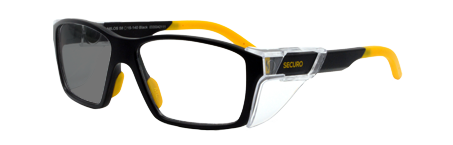
  • Prioritize robust integrated side shields to limit the intrusion of particles.
  • Match surface coatings to tasks: anti-glare when glare is a factor, enhanced scratch resistance for abrasive environments, and appropriate filters when a radiation source is involved.
  • Make clinic fitting systematic to ensure comfort and continuous wear. Uncomfortable glasses usually end up at the bottom of a drawer.
  • Plan maintenance: hard cases, cleaning stations in key areas of the plant, and clear cleaning instructions to preserve optical clarity and service life.

Budget, cost control, and return on investment

The cost of a corporate program depends on the scope of eligibility, prescription complexity, and the options selected.

Three levers can help improve budget control:

  • standardize an optimized set of options by work environment;
  • consolidate purchasing and billing to gain monthly visibility and economies of scale;
  • avoid case-by-case reimbursements that make administration heavier.

From a structural standpoint, programs generally include:

  • a cost per pair that includes the certified safety frame, prescription lenses, coatings, and clinic service;
  • centralized billing, often monthly, with reports by site and department.

ROI goes well beyond the unit price. Fewer eye-related incidents, fewer work interruptions, fewer compliance gaps, more consistent wear due to better comfort, and a stronger employee experience all contribute to the value of the program. Real-time visibility into equipment also strengthens your ability to demonstrate due diligence during audits or CNESST inspections.


Governance and continuous improvement

  • Appoint one lead per site and a national program owner who meet periodically.
  • Update your risk mapping when processes change, new machinery is introduced, or new sites open.
  • When the agreement is renewed, the account manager reviews whether the products still meet your needs and discusses new options where relevant.
  • Train managers and new employees on how to wear and maintain safety glasses.

How Securo Vision can support your corporate program without adding complexity

The role of Securo Vision is to simplify, standardize, and secure your program. With an extensive network of partner clinics across Quebec and Canada, frames that comply with CSA Z94.3standards, customized lenses, and a clear eligibility management portal, you can roll out your program quickly while maintaining control over compliance and costs. To see how ordering works in practice for your teams, visit our dedicated page. For a broader overview, explore the corporate program.

Quick checklist to get started

  • Assess eye hazards by position and protect your teams.
  • Define eligibility, baseline options, and replacement rules.
  • Select a partner offering CSA Z94.3 certified frames, a clinic network, and centralized management.
  • Set up the catalog and eligibility portal.
  • Train HR and EHS contacts and prepare the communication kit.
  • Launch in waves, track indicators, and adjust as needed.

Conclusion and next steps

Implementing a corporate prescription safety glasses program is one of the most practical prevention measures you can take for employees exposed to eye hazards. It is a structured approach that aligns with Canadian and Quebec regulatory requirements, simplifies administration, strengthens compliance, and improves the employee experience. The key is to move forward methodically: map hazards, standardize options that comply with CSA Z94.3 standards, create a smooth employee journey, and manage the program with clear performance indicators.

Would you like to evaluate the right setup for your business, estimate your budget, or plan a pilot rollout in Quebec or elsewhere in Canada? Speak with our specialists. Request a quote today!

Useful resources

Note: These references are provided for general information on the regulatory framework and best practices. For the operational rollout of a corporate prescription safety glasses program, your team and our specialists can adapt the approach to your sites, risks, and objectives.

The largest network of partner clinics in Canada