Back to articles

Does a Company Have to Provide Prescription Safety Glasses in Quebec?

Discover the obligations of Canadian employers

For an employer operating in Canada, and especially in Quebec, the issue of safety glasses is not just a simple employee benefit. It directly concerns the obligation to protect health and safety at work. When the risk assessment indicates a danger to the eyes, the employer must provide compliant eye protection and ensure it is worn. As soon as a worker needs vision correction to perform their duties, the eye protection must be compatible with that reality. In many cases, this means putting in place a corporate prescription safety glasses program that balances compliance requirements, comfort, and visual performance.

This guide gives practical answers to the employer-obligation question, presents the Canadian and Quebec regulatory framework, explains applicable standards such as CSA Z94.3, and then provides practical advice for implementing an effective and cost-efficient corporate program. You will also find links to official sources for further reading.

Key takeaway: if your risk analysis requires eye protection and your employees need vision correction, you must provide a solution that is compliant and compatible with their vision—very often, through prescription safety glasses.

What the laws say in Quebec

In Quebec, the employer’s general obligation is set out in section 51 of the Act respecting occupational health and safety. Among other things, the employer must provide the required personal protective equipment free of charge and ensure that the worker uses it: see LégisQuébec – AOHS, S-2.1.

This obligation is clarified in the Regulation respecting occupational health and safety. Section 343 makes it mandatory to wear eye or face protection that complies with CSA Z94.3 for any worker exposed to hazards that may cause injury to the eyes or face (particles, dangerous substances, molten metals, intense radiation). Reference: LégisQuébec – ROHS, S-2.1, r. 13 (s. 343).

The CNESST reminds employers that they have clear responsibilities in prevention. They must first identify, analyze, and prioritize the risks present in the workplace (CNESST, Identify risks in the workplace). They are also required to provide workers with the necessary personal protective equipment (PPE) free of charge, ensure it is used properly, and maintain it (CNESST, Personal protective equipment). In addition to these measures, the employer must adequately inform and train workers on the risks they are exposed to and the means of preventing them (CNESST, Employers’ obligations and right). All of these obligations fit within a structured prevention program aimed at protecting occupational health and safety (CNESST, Prevention program).

For federally regulated workplaces, the Canada Labour Code also requires the provision and maintenance of necessary PPE: Fact sheet.

What should you take away about prescription safety glasses?

  • If your risk analysis concludes that eye protection is required, the employer must provide it free of charge and require that it be worn.
  • CSA Z94.3 requires impact resistance and protective coverage that ordinary prescription glasses do not provide.
  • When the worker wears vision correction, the protective solution must be compatible with their vision: compliant protection worn over prescription eyewear, provided it is truly usable without compromising safety or visual quality.

CSA Z94.3 and its practical implications

In Canada, CSA Z94.3 sets out the performance, testing, and labeling requirements for eye and face protectors. It covers both sans prescription et avec prescription. It addresses impact resistance, side protection, optical quality, material durability, and clear identification of compliance. In practice, if your safety glasses do not meet this standard, they are not acceptable for workplace use. To learn more: CSA Group – standards and certification.

Consequences for organizations:

  • Safety glasses for prescription eyewear must be made with certified frames and impact-resistant lenses according to the established criteria.
  • Side shields must provide adequate coverage. Regular prescription glasses with small clip-on side shields are not acceptable if they do not meet CSA Z94.3.
  • Selection, fitting, maintenance, and periodic replacement are all part of a compliant program. Plan for regular checks of fit and equipment condition.

Choosing and implementing the right solution

There are two main approaches to protecting workers who wear vision correction:

  1. Compliant protection worn over prescription glasses: suitable for occasional use or visitors, but with frequent limitations (comfort, fogging, slipping, peripheral vision) and lower day-to-day acceptance.
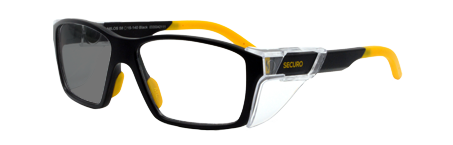
  2. CSA prescription safety glasses (CSA Z94.3 compliant): vision correction built into safety frames that provide full protection. This option supports comfort, clear vision, and consistent wear, which increases compliance and reduces injuries.

The final decision depends on the risk assessment and the reality of the tasks. If the employee must wear glasses all day to operate machinery, read instruments, or perform precise tasks, safety glasses for prescription eyewear are generally the safest and most effective solution. Useful resource: Canadian Centre for Occupational Health and Safety.


Assessing eye hazards

Your policy starts with a rigorous analysis.

Typical hazards to consider:

  • Flying particles and debris: grinding, cutting, sanding, carpentry, mechanics.
  • Chemical or biological splashes: laboratories, food processing, industrial cleaning.
  • Molten metals and hot projections: foundry, welding, cutting.
  • Intense radiation: welding arc, UV exposure in outdoor work.
  • Airborne dust and bioaerosols.
  • Temperature and humidity changes that cause fogging.

Specify the required impact level, the need for side and top protection, compatibility with other PPE (helmet, mask, respirator), and the optical needs of the role. This set of requirements will guide the selection of frames, lenses, and treatments.


Technical features to prioritize with the supplier

  • CSA Z94.3 compliance that can be verified (certification evidence and markings).
  • Robust wraparound frames, integrated side shields, stable fit.
  • Impact-resistant lenses (often polycarbonate), high optical quality.
  • Durable anti-fog and scratch-resistant coatings.
  • UV protection for outdoor work; photochromic options are useful for indoor/outdoor settings.
  • Single-vision, progressive, or role-specific solutions (near work, intermediate zones).
  • Compatibility with respirator masks and helmets to reduce fogging.

Implementing a frictionless corporate program

Structure your approach in 5 steps:

  1. Policy and eligibility: link provision to the risk assessment; define covered parameters (frames, lenses, coatings, frequency); and set out exceptions.
  2. Selection of solutions: offer a range of compliant frames suited to the environment (plant, jobsite, laboratory, outdoors) and comfortable for extended wear.
  3. Simple employee journey: centralized eligibility management; appointments with partner opticians/optometrists; measurements, eye exam if needed, guided selection; manufacturing, fitting, delivery of a hard case, and care instructions.
  4. Monitoring and traceability: keep records of model, markings, and dates; fit and wear reminders; prescription updates; integrate into PPE inspections and audits.
  5. Training and communications: explain the risks, the limitations of regular glasses, and the benefits of compliant protection; remind workers to wear them as soon as they enter a risk area; provide cleaning stations; and set up fast replacement procedures for breakage.

Cost-effectiveness and best practices

Cost-effectiveness and best practices preventive investment. The direct costs of a compliant pair are offset by fewer injuries, less downtime, fewer claims, and higher productivity thanks to clear vision throughout the shift. A structured policy helps control the budget through standardization of approved frames, negotiated pricing, centralized billing, and planned replacements. From an accounting perspective, PPE generally falls under operating expenses and fits within prevention plans recognized by the CNESST.

Daily best practices:

  • Require an up-to-date prescription to optimize visual performance.
  • Check the fit at handoff, then recheck it regularly.
  • Replace damaged glasses without delay (scratches, impacts).
  • Plan solutions for remote sites and night shifts.
  • Deploy treatments suited to the environment (anti-fog wipes, scratch-resistant coatings, photochromic lenses).
  • Review user feedback to adjust the program.

Key points by sector

  • Construction and jobsites: robust wraparound frames, impact-resistant and scratch-resistant lenses, UV protection, anti-fog.
  • Manufacturing and processing: extended comfort, precise vision (instrument reading), anti-fog in variable microclimates, compatibility with helmets and masks.
  • Food processing and healthcare: easy cleaning and disinfection, anti-fog, stable frames compatible with masks, protection against chemical and biological splashes.
  • Energy, mining, and forestry: maximum durability, resistance to shocks and harsh conditions, reinforced side protection, photochromic lenses depending on exposure.

In short: the employer’s obligation

The initial question: does a company have to provide prescription safety glasses in Canada and Quebec?

  • Yes, if the risk assessment concludes that eye protection is necessary: the employer must provide it free of charge and require it to be worn (AOHS, s. 51).
  • Eye or face protection must comply with CSA Z94.3 standards and be worn whenever exposure to danger exists (ROHS, s. 343).

As soon as the worker requires vision correction S-2.1, r. 13 - Regulation respecting occupational health and safety to perform their duties, the employer must provide an eye-protection solution that is compliant and compatible with that correction. In most environments where corrected vision is continuously required, the most logical and effective solution is to provide vision correction safety glasses.

Beyond compliance: tangible benefits

A well-designed prescription safety glasses program reduces injuries, improves precision, supports quality and productivity, strengthens the prevention culture, and simplifies PPE management. Employees receive a clear message: the organization is investing in their safety and visual comfort. This alignment between regulatory requirements, ergonomics, and operational performance is a best practice in occupational health and safety.

How Securo Vision can support you

Based in Quebec, Securo Vision helps Canadian organizations implement prescription safety glasses programs that comply with CSA Z94.3. standards. Our approach brings together certified frame selection, lens and coating options suited to your risks, a large network of eye care professionals, a simplified employee journey, and management tools that lighten the administrative burden. Discover how our solutions fit your operational reality and prevention goal: Securo Vision.

Would you like to compare options for your production units, jobsites, or laboratories? Speak with a Securo Vision specialist to build a clear policy, an approved assortment, and simple processes that encourage consistent wear and reduce eye-related incidents.

Ready to structure your program?

Ready to structure a safety glasses program for your teams in Quebec and across Canada? Explore our solutions and contact us for a free assessment.

The largest network of partner clinics in Canada